

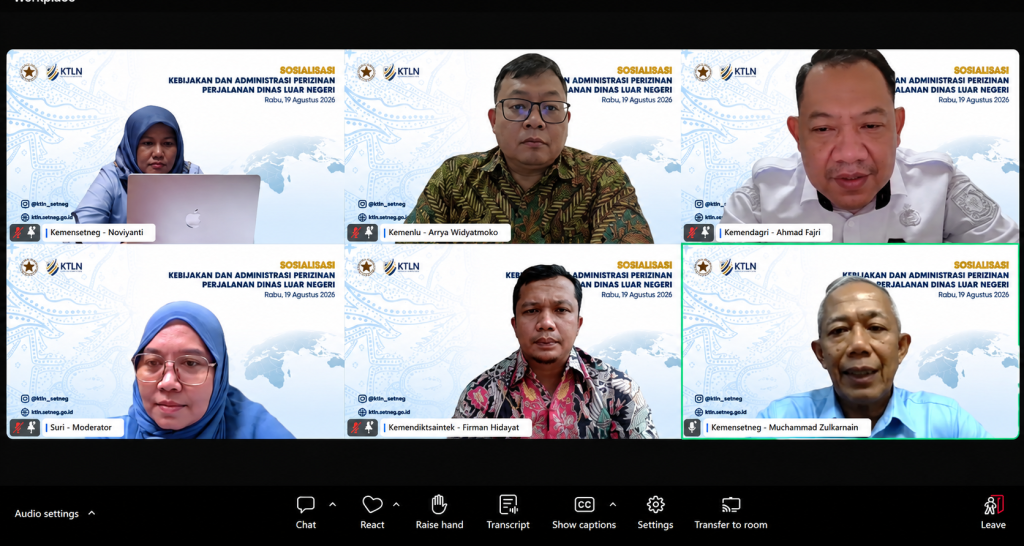
On August 19, 2026 — The Head of the International Office of Universitas Islam Negeri (UIN) Alauddin Makassar, Dr. Serliah Nur, M.Hum., M.Ed., participated in the webinar “Socialization of Policies and Administration for Overseas Official Travel Permits in 2026,” held online via Zoom on Wednesday, August 19, 2026.
The webinar discussed the policies and governance of Overseas Official Travel (Perjalanan Dinas Luar Negeri/PDLN), covering travel permits, administration, implementation, and evaluation for ministries/agencies, higher education institutions, and local governments. The event featured five speakers from various government ministries and institutions, followed by a discussion session moderated by Suri Hidayati, S.Sos., M.Si., Senior Policy Analyst at the Bureau of Foreign Technical Cooperation, Ministry of the State Secretariat.
The first speaker, Novianti, S.IP., M.A.I.D., Head of the Bureau of Foreign Technical Cooperation, Ministry of the State Secretariat, explained that overseas official travel is part of official duties and represents the state; therefore, it requires formal authorization regardless of the source of funding. She emphasized that overseas official travel must be conducted effectively, efficiently, selectively, and with clear benefits, as well as having strong urgency and relevance to the institution’s duties and functions. Applications should ideally be submitted at least seven days before departure, accompanied by a concise but substantive Terms of Reference (ToR) outlining the purpose, participants, benefits, cost-benefit considerations, and follow-up plans.
The second speaker, Muchammad Zulkarnain, S.H., M.A., Head of the Bureau of Administration for State Officials, Ministry of the State Secretariat, discussed the administrative aspects of overseas official travel for state officials, including the importance of appointing an Acting Minister (Minister Ad Interim) to ensure the continuity of government functions when a minister travels abroad.
From the higher education perspective, Firman Hidayat, S.S., M.Si., Head of the Evaluation and Cooperation Division at the Bureau of Cooperation, Ministry of Higher Education, Science, and Technology, emphasized that overseas official travel should be aligned with the university’s targets, performance indicators, and strategic objectives. Its success should not be measured merely by the number of trips or partnerships established, but by tangible outputs and outcomes such as joint research, publications, joint degree, and double degree programs. He also highlighted the importance of internal screening, proper administrative procedures, and post-travel reporting.
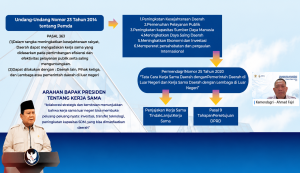
Meanwhile, Ahmad Fajri, S.H., M.H., Head of the Center for Cooperation Facilitation, Ministry of Home Affairs, presented the perspective of local governments. He explained that international cooperation should uphold the principles of efficiency, effectiveness, public service, and mutual benefit. Verification should be strengthened, particularly regarding the number of participants, duration of travel, urgency of activities, and the relevance of participants’ positions to the activities.
The final speaker, Arya Widyatmoko, S.IP., M.A., M.Dip., Senior Diplomatic Officer at the Directorate of Consular Affairs, Ministry of Foreign Affairs, discussed consular services related to overseas official travel, including official passports, exit permits, visas, and diplomatic coordination. He emphasized the importance of complete documentation and thorough planning to prevent administrative difficulties and repeated processing.
The discussion session addressed various practical issues, including overseas official travel for study assignments, official passport and exit permit procedures, verification mechanisms, and required documentation.
For UIN Alauddin Makassar, particularly the International Office, the webinar provided important insights into the proper and strategic management of international cooperation and academic mobility. Overseas official travel should not be viewed merely as international travel, but as part of institutional duties that must have clear objectives, urgency, outputs, and benefits.
At the conclusion of the webinar, Novianti emphasized that overseas official travel should serve as a means for growth, rather than an end or personal benefit. International travel is expected to provide opportunities to expand knowledge and networks, strengthen international collaboration, and bring meaningful benefits back to institutions and Indonesia.
The participation of Dr. Serliah Nur, M.Hum., M.Ed. in this webinar reflects the International Office of UIN Alauddin Makassar’s commitment to strengthening the governance of international activities in an effective, efficient, selective, transparent, accountable, and results-oriented manner.