

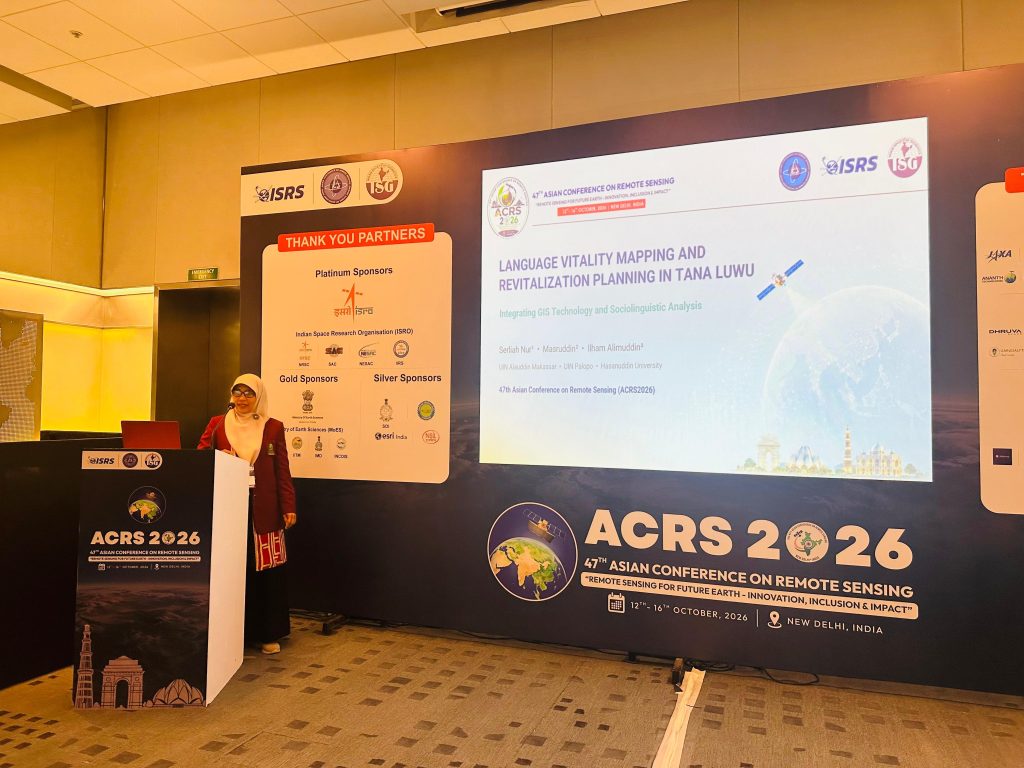
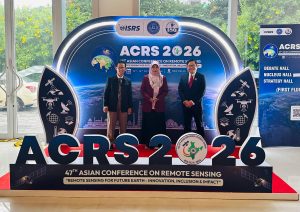
NEW DELHI, INDIA – Dr. Serliah Nur, M.Hum., M.Ed., Head of the International Office (IO) and also as the Secretary of the Master’s Program in English Language Education at the Postgraduate School of UIN Alauddin Makassar, presented collaborative research at the 47th Asian Conference on Remote Sensing (ACRS 2026), held in New Delhi, India, on October 12–16, 2026.
The Asian Conference on Remote Sensing (ACRS) is an international scientific conference that brings together researchers, academics, professionals, and industry representatives to share advances in remote sensing, geospatial technologies, and their practical applications. The conference serves as a platform for scientific exchange, interdisciplinary collaboration, and the development of innovative approaches to addressing regional and global challenges.
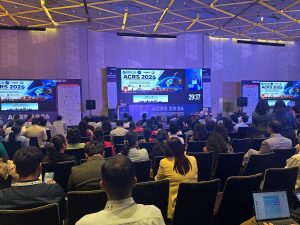
The 2026 conference, themed “Remote Sensing for Future Earth: Innovation, Inclusion and Impact,” brought together nearly 800 participants from 20 countries, including researchers, academics, geospatial industry practitioners, and delegates from space agencies. The event provided an international platform for exchanging knowledge and presenting research on the development and application of remote sensing technologies across various fields.
At the conference, Dr. Serliah presented a collaborative research project entitled “Language Vitality Mapping and Revitalization Planning in Tana Luwu: Integrating GIS Technology and Sociolinguistic Analysis.” The study was conducted in collaboration with Prof. Dr. Masruddin from UIN Palopo and Dr. Ilham Alimuddin from Hasanuddin University.
During her presentation, Dr. Serliah highlighted the challenges facing several local languages in the Tana Luwu region, which encompasses Luwu, North Luwu, East Luwu, and Palopo City. The languages examined included Tae’, Rongkong, Wotu, and Limola. Rapid urbanization, population mobility, and the increasing use of Indonesian as a common language have contributed to the declining use of local languages, particularly among younger generations.
“Threats to local languages do not only mean the loss of communication tools, but also the loss of cultural identity, local wisdom, and the collective memory of local communities,” Dr. Serliah explained.
A key innovation of the research lies in its integration of sociolinguistic assessment based on the UNESCO framework with geospatial technologies, including Geographic Information Systems (GIS) and remote sensing. This interdisciplinary approach enables researchers to identify and map areas where local languages remain widely used, as well as areas where they face a heightened risk of extinction.
Preliminary findings revealed differences in language vitality between urban and rural areas. Local languages remain relatively prevalent in rural and mountainous communities, while their use has continued to decline in urban settings, particularly in Palopo City. The Limola language, in particular, faces a significant risk of extinction as its speaker population continues to decrease.
Building on these findings, the research team plans to develop a Digital Language Vitality Atlas of Tana Luwu through participatory mapping and spatial data analysis. The atlas is expected to serve as a valuable resource for local governments in formulating language preservation policies, integrating local languages into educational curricula, and developing community-based revitalization initiatives.
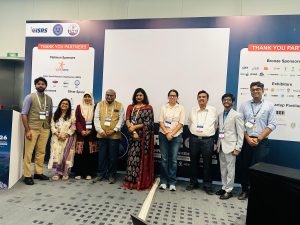
Dr. Serliah’s participation in ACRS 2026 reflects UIN Alauddin Makassar’s commitment to strengthening the international engagement of its academic community and promoting interdisciplinary research with practical relevance to local communities. Her involvement also contributes to expanding the university’s international academic networks and bringing local cultural and linguistic issues to a broader global audience.